

Work Experience at the Maison Française
by Arjun Sabharwal (Year 11, Cherwell School)
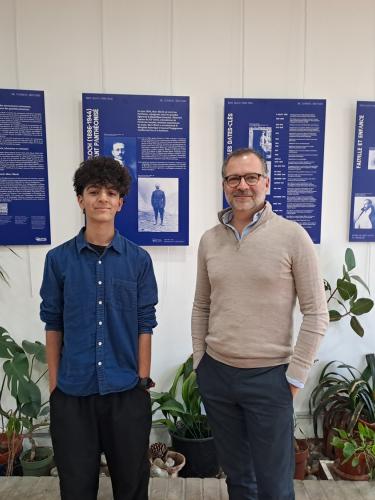
October 2026
At the beginning of the month, we had the pleasure of welcoming Arjun Sabharwal from Cherwell School for a week of work experience. We’re delighted to share the short article he wrote about his time with us!
Thank you, Arjun, for your enthusiasm and contribution. We hope to welcome you back soon!
"Hello! My name is Arjun, and I am a Year 11 student at Cherwell School in Oxford. Between 5 and 9 October, I did my work experience placement at the Maison Française d’Oxford. The Maison is an institution created to link the University of Oxford with major French universities, such as Université Paris 1 Panthéon-Sorbonne, and research institutions such as the CNRS. It is home to several research projects and researchers working in fields such as anthropology, sociology and history. This meant that I had the opportunity to meet many people working on all kinds of unique projects, such as the NOTCOM project (which deals with scientific consensus in the early modern period) and research on forest management.
During this week, I worked with Anne-Sophie Gabillas, who oversees programmes and outreach. Her role includes helping to organise events, such as the exhibition on Marc Bloch, which I assisted in setting up, as well as managing the Maison’s communications and PR. She is also involved in organising cultural activities and promoting engagement with research through a programme of events, such as the exhibition in the front garden to mark the MFO’s 80th anniversary.
On Monday, I arrived at the Maison Française at ten o’clock and met my supervisor. She showed me around the building, explaining its architecture and the different areas within the Maison. The Maison stands out among the several impressive buildings in Oxford. While many of the others have a more traditional style, with an incomparable charm, the Maison is distinctive in its own way, with architecture that cannot be mistaken for any other building. She also explained the history of the organisation: how it moved from building to building before finally having a space built for it in the 1960s, in the form of the building I was now standing in. Later in the day, I had the opportunity to talk to her about her job and how it has changed over the nine years she has been doing it, particularly how AI has changed the way she approaches tasks related to outreach for the Maison.
On my first day, as part of a study day, I watched a presentation on Marjane Satrapi’s autobiography, and it was very interesting, especially seeing how the movie Persepolis was made frame by frame. All the researchers present in the room gave the speaker 100% of their attention and asked deeply thought-out and engaging questions. I would say I learnt a few things about how I should present myself when listening to people and trying to contribute to an environment where the speaker feels that they are being truly listened to. I didn’t have a good enough grasp of conversational French, but everyone was very kind and understanding and spoke to me in English. After the presentation, I helped Anne-Sophie prepare some posters for an exhibition on Marc Bloch, an extremely influential French historian.
On Tuesday, I spoke with Catherine, and she told me about what her job involves. She explained the work that goes into bringing students from France to stay at the Maison, and that, due to Brexit, stays are much shorter than they used to be. I got a chance to speak with two students currently doing their PhDs, and it was interesting to hear about the similarities between India and France. I also got the opportunity to talk to a sociologist named Vera, who explained the study she is currently doing about how scientists research carbon levels in forests. She told me about how she has been to different places and how different scientists have access to different amounts of resources, and I was truly moved by how many scientists in places like East Africa have extremely limited resources for the magnitude of the work they are doing.
During lunch, I talked to a few people currently at the Maison for different reasons, and being surrounded by so many people who are experts in their respective fields is something I had never experienced before. However, along with being very knowledgeable and skilled, people here are welcoming, warm and jovial. I enjoyed talking to people about all sorts of issues and happenings during lunch, especially all kinds of stories about their life experiences.
After lunch, I helped Janet in the Maison’s impressive library. The library is almost like a different building, with its wooden roof and walls and walls of books. I was given a library card, and Janet showed me the process of locating books related to subjects that people ask her about, in this case, English literature. I was given the challenging task of locating a book in the vast collection the Maison had, and in the process, I was amazed by the range of books available to people in the Maison’s library. For example, in the same library, you could find some of the best books on history, as well as a range of French children’s books, both available to everybody who has a library card, which Janet made for me.
Living in Oxford, I’m lucky to have libraries like this so easily available to me. The atmosphere in the library is extremely helpful for work, with everyone sitting down and fully focused. This meant that even someone with as short an attention span as me was able to get some work for my GCSE music composition done in about 30 minutes, work that would ordinarily have taken me the best part of an hour.
On Wednesday, I had a conversation with Emmanuelle, a historian of dance and performance. We discussed the importance of recognising the impact and originality of the hard work people put into creative industries, both in the past and in the present. We spoke especially about the increasingly concerning use of AI for music production, instead of putting in the hard work and time required to create a meaningful piece of music, and how AI itself is destroying the meaningfulness that makes art what it is.
The relaxed atmosphere at the Maison during lunchtime was always something I looked forward to during my lunch break, as everyone is friendly and always interesting to talk to about several pressing and relevant issues that are often too complex to try to comprehend all by yourself. I ended the day as I had got into the habit of doing, sitting in the library and working my way through not only the article but also the seven pieces of horrendous homework I discovered were due for the week back. There wasn’t a room in the Maison that could compare to the peaceful and tranquil library. The library was almost like some Edenic place of solitude in which everybody reaches their peak focus and productivity, as if it were some kind of haven for people trying to get things done.
On Thursday, I had the opportunity to talk to Niall, a junior researcher at NOTCOM, a five-year research project in the history and philosophy of science. He explained the work they do and how they have investigated the importance of collaboration within scientific research. NOTCOM is based in the basement of the Maison, and even though it feels like a separate part, it is an integral part of the Maison. Niall explained that, even though the idea of singular geniuses is widely promoted, this is rarely the case. He said that NOTCOM worked because of collaboration, and the entire office was designed with that in mind. He expressed his desire for people to engage with their work through the blogs, podcasts, etc. that they publish.
He explained that, as in the present day, scientific development has never been something that can be achieved by any one person. Scientific research and development of a high calibre require collaboration. One challenge he mentioned was trying to understand the impact and calibre of your own research, which he described as another reason to prioritise working with other people, both formally and informally. With so many researchers at the Maison, it feels like some sort of hub of intelligence and skill, like no place I’ve ever been.
On my final day, I helped Anne-Sophie and Antoine set up for the exhibition by putting up all the posters, and I got to see the process of setting up an event like this. It was nice to know that I was part of the team that made this incredible exhibition about the life of Marc Bloch happen, so even if my contribution was very small, I did have a part in it as well.
Overall, I would say that the entire experience at the Maison has been something I will never forget. I met some of the most skilled and intelligent people, who were also welcoming and fun. They always involved me in conversations and made sure I understood what they were talking about. I especially enjoyed talking about issues that are too complicated to discuss just with friends and hearing their points of view. I hope that more people begin to engage with the work that organisations like NOTCOM and the Maison are doing, because people put a lot of hard work into the exhibitions they organise every term, and they are worth seeing and supporting, especially if you live in Oxford."