

Double Book Launch: Contemporary Hindu Nationalism and the Politics of Predatory Capitalism in Karachi
Similar events
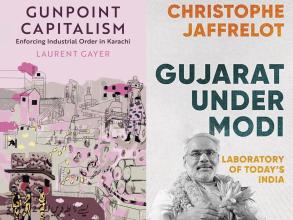
Christophe Jaffrelot and Laurent Gayer will be presenting their latest books, respectively Gujarat Under Modi: Laboratory of Today's India (Hurst, 2024), following Modi's India: Hindu Nationalism and the Rise of Ethnic Democracy (Princeton University Press, 2021), and Gunpoint Capitalism: Enforcing Industrial Order in Karachi (Hurst and Oxford University Press, 2025).
Christophe Jaffrelot, Gujarat Under Modi: Laboratory of Today's India, Hurst, 2024
In 2012 Narendra Modi became the first Hindu nationalist politician thrice elected to lead a state of the Indian Union, his stewardship as Chief Minister of Gujarat being the longest in that state's history. Modi and his BJP supporters explained his achievement by pointing to economic growth under his leadership, yet detractors point out that Modi has been more business-friendly than market-friendly-to the benefit of large industrial corporations, and at the cost of great social polarisation.
In 2002, an anti-Muslim pogrom of unparalleled ferocity occurred in Gujarat, leading to the biggest number of Muslim deaths since Partition. The state's Hindu majority immediately rallied around Modi. No serious riot has occurred in Gujarat since, but polarisation was key to Modi's strategy there, and he has deployed that strategy again and again since he became Prime Minister of India in 2014. For Modi has cultivated a communal image. A marketing genius, his messaging combines the politics of Hindutva with economic modernisation, to the clear appreciation of Gujarat's middle class.
Christophe Jaffrelot's revealing book shows how Modi's Gujarat served as the laboratory of Modi's India, not only in terms of Hindu majoritarianism and national populism, but also of caste and class politics.
Laurent Gayer, Gunpoint Capitalism: Enforcing Industrial Order in Karachi, Hurst and Oxford University Press, 2025
On 11 September 2012, over 250 workers of Ali Enterprises, which produced jeans for the German discount retailer KiK, perished in a fire in their Karachi factory. Was this an accident or an arson attack? Straight away, the tragedy gave rise to contradictory interpretations. While some blamed the exploitative logics of fast fashion, others suspected foul play by the political parties preying on the city and its business class.
Taking as a starting point the controversy caused by this disaster, Gunpoint Capitalismplunges us into the murky waters of globalisation. Exploring the back alleys of Pakistan's industrial capital city, it shows how the manufacturing economy makes order out of disorder, and profit out of conflict-to the detriment of workers. In Karachi, as elsewhere, petty criminals and ex-servicemen prove to be formidable enforcers of economic order. A comparison with Europe, the United States and Latin America confirms the central place of such henchmen in the dynamics of capitalism. These shock troops of anti-unionism are now participating in the dismantling of the social state.
This probing, sometimes shocking, book sheds new light on the power structures, organised violence and daily labour struggles underpinning the production of our consumer goods.
Christophe Jaffrelot is CNRS Senior Research Professor at CERI-Sciences Po, and Avantha Chair and Professor of Indian Politics and Sociology at the King's India Institute. He recently published Modi's India, Gujarat Under Modi, India's First Dictatorship: The Emergency, 1975 -1977 (co-authored with Pratinav Anil), as well as The Pakistan Paradox: Instability and Resilience.
Laurent Gayer is CNRS Senior Research Professor at CERI-Sciences Po. He focuses on political conflict and urban transformations in India and Pakistan. He is the author of Gunpoint Capitalism: Enforcing Industrial Order in Karachi (2025) and Karachi: Ordered Disorder and the Struggle for the City (2014), as well as the co-editor of Shared Sacred Sites in South Asia (2026), Muslims in Indian Cities: Trajectories of Marginalisation (2011), and Armed Militias of South Asia (2009). He is also the co-author of Proud to Punish: The Global Landscapes of Rough Justice (Stanford University Press, 2023).