

'Sovereignty, Spirituality, and the Subsoil in the Duchy of Savoy'
Similar events
Joint session with the Early Modern Italian World Seminar
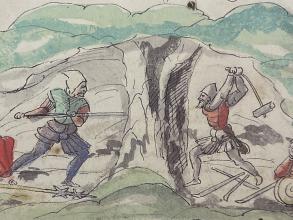
Das Schwazer Bergbuch. Der Bochumen Entwurf von 1554 Faksimile, Christoph Bartels, Andreas Bingener, Rainer Slotta (ed.), Band I, Bochum
Caroline Callard (EHESS)
Subterranean worlds are often understood in terms of distinct categories: a natural environment and repository of resources, a world of extractive labour, or a space of invisible powers and the afterlife. These divisions, inherited from modern scholarly categories, tend to separate what early modern societies thought and governed jointly. The social sciences have recently proposed rethinking territories as volumetric configurations, made up of thicknesses and vertical circulations, where the top, bottom and undeground are interdependent in the exercise of power.
This paper situates these debates historically through a specific case study: the Duchy of Savoy in the sixteenth century, showing how the subsoil became a space of government in its own right, where law, expertise, extraction and spiritual practices were articulated. The paper thus tests the idea that sovereignty is constructed not only at borders and on a horizontal plane, but also in depth, within a territory conceived in its three-dimensionality.
In the Duchy of Savoy, the years 1530-1532 marked a complete reorganisation of the governance of mineral resources, when Charles III gave mining an articulated form of state control. It was, however, the French occupation of 1536 that brought these issues into sharp relief: what happens to the governance of the underground when a territory is occupied and contested? Through ordinances, correspondence and conflicts, the subsoil then appears as a political laboratory, where the continuity of the state and the legitimacy of power are put to the test. In a context of wars perceived as times of panic, mines were not only a matter of economics or technology: they were also imbued with moral and religious imaginaries, where suspicions of heresy, occult knowledge, and acts of exorcism intersected. Thus, when Emmanuel-Philibert regained his states in 1559, he also had to reassert control over an invisible world and the powers that inhabited it: below the surface.