

Workshop ‘Science, Critique and Opinion: Challenges for scientific consensus’
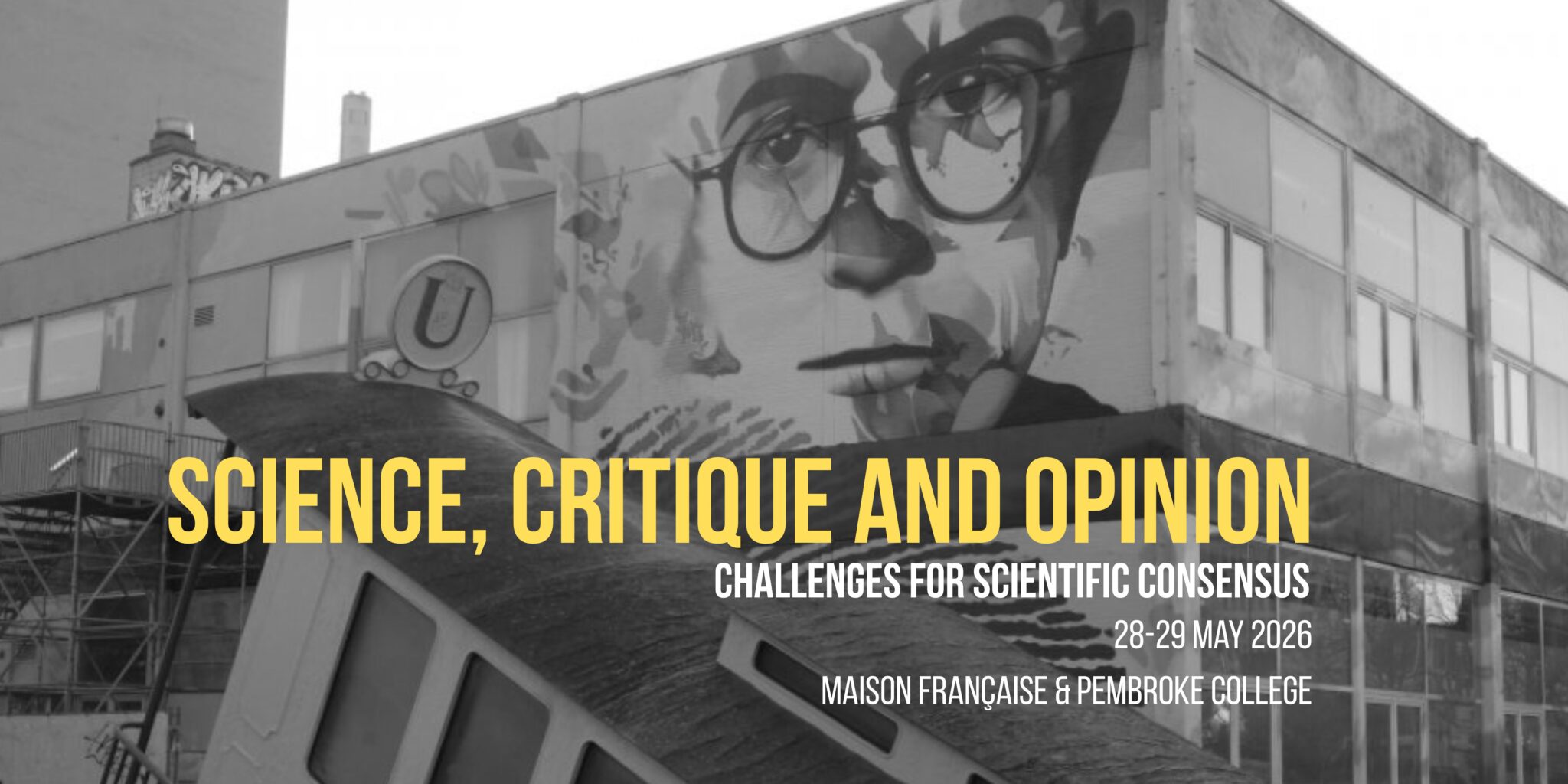
Convened by Amélie Berger-Soraruff (MFO/NOTCOM)
NOTCOM is pleased to announce its upcoming conference “Science, Critique and Opinion: Challenges for Scientific Consensus”. This event will take place on 28-29 May 2026. It will be held at the Maison Française d’Oxford on the first day, and at Pembroke College on the second day.
Download the programme here.
Description:
The Covid pandemic saw a rise in science scepticism and conspiracy theories. From the anti-vaccine movement to the newfound popularity of alternatives medicines, the lack of trust in scientifically informed discourses has left many researchers concerned. These developments are not unique to the discussions of Covid. For decades now, the scientific community has warned the public about the global threat to the environment posed by the industrial economy, with little effects on environmental policies or public behaviour. It is now more than three decades ago, in 1992, that the manifesto “World Scientists’ Warning to Humanity” was released (Kendall et al. 1992). It was revised in 2017 at the occasion of the COP23 (Ripple et al. 2017). Groups like The Internation Collective, formed in 2019, reminds us that while the challenges that have arisen with climate change have been clearly “identified, qualified and quantified,” our collective inability to change the course of action is worrying (Stiegler and Internation Collective 2021: 36). Reasons for this inaction are multiple. For philosopher Bernard Stiegler, this situation amounts to a society that lives in denial, but also a science that is not “unified” enough and must reclaim its unity as a discourse, but also its legitimacy as a discipline (2020).
This thirst for unity and consensus stands at odds with previous generations of academics who warned us against excessive confidence in science and consensus. Counter-enlightenment thinkers such as Horkheimer, Adorno, Marcuse and Benjamin, for example, highlighted the violence of modernity, and its will to totalize truth. In the 1970’s, the so-called postmodernist turn taken by figures like Foucault, Lyotard or Derrida, further challenged this state of affairs. A typical move of this tradition of philosophers was to insist on plural truths, language games, and historical contexts. Deleuze’s theory of societies of control, Baudrillard’s provocations on hyperreality, and Latour’s examination of the production of scientific results, to cite only a few, taught us to question the supposed authority of knowledge-claims.
While commentators were quick to mock the “leftist thinkers” taste for debunking dominant ideologies and re-imagining reality (Gross & Levitt 1994), this was not without consequence for the appreciation of scientific discourse in the public sphere. For a start, the professed “incredulity” towards metanarratives, to quote Lyotard, seemed to undermine the desirability of scientific consensus (Lyotard 1979: xxiv). Science was accused of legitimizing itself by illegitimate means. The postmodern turn also allowed the presentation of truth as a construct, hence heralding a post-truth era where all views are deemed equally valid or defensible. Criticized for undermining the possibility of objective truth, Latour himself observed that the distrust for “good matters of fact” now constituted the real danger. He deplored the growing conflation of social critique and conspiracy theorizing (Latour 2004: 227). For him, if became important to educate the public about what makes a science a science, and foster dialogue between experts and the general audience: “If you want people to have some grasp of science, you must show how it is produced” (Latour 2020).
Another important factor to consider in the current crisis of consensus is the role of technologies in the dissemination of knowledge. As tech companies like Apple, Google or Microsoft enjoy near total control over the primary channels of information, such as search engines and generative conversational tools, this further undermines the spread of a unified and coherent scientific discourse. Websites, as we know, rely on algorithms to select content and show information to their users based on preferences. In doing so, they “reduce exposure to counter-attitudinal information” (DeVito 2017), and so reduce possibilities for debate and exchanges of ideas. In this new regime of digital truth, organised around echo chambers, the biggest risk we face is the creation of a false sense of consensus by gathering audiences who think alike together and reinforcing cognitive biases (Rouvroy & Berns 2013).
The challenge for scholars in the face of these developments is twofold. On the one hand they must contend with the heritage of critical theory and postmodernism; they must reassess what values, norms, structures or patterns of thought are worthy of being put centre-stage again in order to re-establish a common ground of knowledge and move beyond this post-truth paradigm (See Braidotti 2013 and Nussbaum 2010). On the other hand, they are faced with the necessity to collaborate or engage with the general public to rebuild trust in scientific evidence, while at the same time reckoning with the new threats posed by digital technologies.
Aim and scope:
The core focus of this conference will be the perception gap between the scientific community and the general public when it comes to the authority of scientific discourse and scientific consensus. When and why did science start to lose its authority as a discourse? How can we explain this lack of receptivity on the side of the public (and which publics in particular)? What are the solutions, innovations, or strategies put in place by researchers to rebuild trust between institutions, researchers and the broader public? What forms of consensus are desirable without falling back into the perceived violence of modernity?

