

Inayatullah Din
Please tell us about your research project.
I am a third-year PhD candidate in History at the École des Hautes Études en Sciences Sociales (EHESS), Marseille, affiliated with the Centre de recherche sur les circulations, les liens et les échanges (CeRCLEs) and the Centre for South Asian and Himalayan Studies (CESAH). My doctoral research is supervised by Fabrizio Speziale.
My research examines the relationships between empire and environment in the western Himalayas, with a particular focus on Kashmir and its surrounding regions from the sixteenth to the nineteenth century. It addresses the central question of how a State comes into being across different temporal frameworks, and what such processes reveal about the nature of state formation. I approach this question through the analytical lenses of ecology and war, exploring the layered and complex processes involved in the (un) making of the state. This study draws on a diverse corpus of Sanskrit, Persian, Urdu, Kashmiri, and colonial sources.
The project investigates the intricate interactions between the state, war, and the natural environment, demonstrating how these elements have shaped the specific historical trajectories of the Himalayan region. By foregrounding warfare on the margins of empires, it seeks to illuminate underexplored subaltern histories, as well as the political and geographical diversity of the region, offering an alternative to statist narratives.
Methodologically, this is an interdisciplinary project situated at the intersection of environmental and military history, drawing on political ecology as its analytical framework. By adopting a long-term perspective, the study aims to theorize structural dynamics, particularly those that remain under examined in existing historiography.
Could you please tell us a bit more about your scholarship/exchange programme?
I have been selected as a visiting doctoral student through a partnership between my institution, EHESS, and the MFO, for a period of three months. This visit will allow me to conduct archival research at the Bodleian Library and the British Library, while building connections with scholars specializing in my field of research.
First impressions of Oxford/the University?
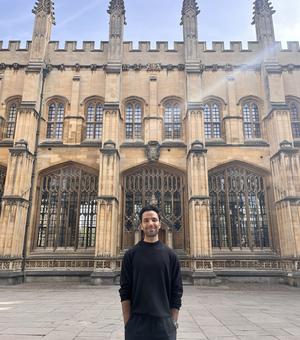
My first impression of Oxford was that it was quite different from France, even though, in some ways, it seemed closer to my native region, Kashmir. I felt as though I had stepped into a time machine, as if I had been transported to the Middle Ages, where one is immersed in history, in the evolution of educational institutions, and in a worldview that places humanity at the center of the universe. At the same time, the city presents itself as a dynamic and cosmopolitan space, offering an intellectually stimulating environment that is highly conducive to research.

