

Book Launch ‘Judges before history/Les juges devant l’histoire’ Jean-Paul Jean (Président de chambre honoraire à la Cour de cassation)
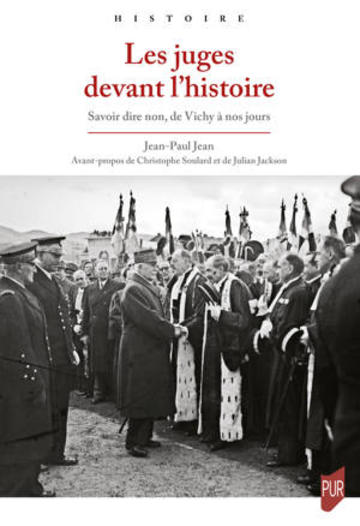
Jean-Paul Jean will present his book, which examines the role of judges under Vichy and during the Purge, drawing on previously unpublished archives to reassess their responsibilities, choices, and the enduring challenges facing justice and the rule of law.
With Lise Jaulin (Liaison Judge, French Embassy in London) I Chair: Anne Simonin (EHESS-CESPRA)
Please note that this talk will be given in French and in English
To receive a link to access this online event, please contact communications@mfo.ac.uk.
FR
Comment des juges, qui ont prêté serment de fidélité au maréchal Pétain et servi le régime de Vichy, ont-ils pu ensuite présider les tribunaux de l’Épuration ? Quel a été le rôle effectif de la justice dans l’application des lois sous l’Occupation, dans la persécution des Juifs et la répression des résistants ? La présentation de parcours de procureurs et de juges tout au long des années noires, attentistes, collaborateurs, résistants, ou vichysto-résistants, remet en contexte les situations concrètes auxquelles les magistrats ont été confrontés et les choix qu’ils ont effectués en conscience. Pourquoi Paul Didier a-t-il été le seul à refuser de prêter serment à Pétain ? Qu’ont réellement fait les magistrats résistants ? De quelle façon la magistrature a-t-elle contribué à l’exclusion des Juifs ? Quelle est la réalité du parcours controversé du vichysto-résistant André Mornet, procureur général qui a requis la peine de mort contre Pétain ? Comment ont été jugés après-guerre les magistrats des sections spéciales ? Pourquoi les procès de l’Épuration n’ont-ils pu s’appuyer que sur des éléments très partiels ? Nombre de documents inédits, provenant des archives publiques et privées, illustrent ces analyses. La remise en perspective de cette période sombre de l’histoire, qui s’éclaire aussi par les réformes de l’après-guerre, dont font partie l’accès à la magistrature des femmes et les prémices de la justice pénale internationale, ouvre au débat sur les enjeux contemporains de la justice, pilier de l’État de droit partout menacé par les dérives populistes et autoritaires.
EN
How could judges who had sworn an oath of loyalty to Marshal Pétain and served the Vichy regime later go on to preside over the courts of the Purge? What was the justice system’s actual role in enforcing the laws during the Occupation, in the persecution of Jews, and in the repression of members of the Resistance?
By presenting the careers of prosecutors and judges throughout the dark years—ranging from wait-and-see attitudes to collaboration, resistance, or the ambiguous position of “Vichy-resisters”—this work places in context the concrete situations magistrates faced and the choices they made in conscience. Why was Paul Didier the only one to refuse to swear an oath to Pétain? What did resistance-minded magistrates actually do? How did the judiciary contribute to the exclusion of Jews? What is the reality behind the controversial career of André Mornet, the “Vichy-resister” and prosecutor general who called for the death penalty against Pétain? How were the judges of the special sections tried after the war? Why were the trials of the Purge able to rely only on very partial evidence?
Drawing on numerous previously unpublished documents from public and private archives, the book sheds new light on this period. By placing this dark chapter of history in perspective—also illuminated by post-war reforms, including women’s access to the judiciary and the early foundations of international criminal justice—it opens a broader debate on the contemporary challenges facing justice, a cornerstone of the rule of law now widely threatened by populist and authoritarian drift.
Les juges devant l’histoire. Savoir dire non, de Vichy à nos jours, Presses Universitaires de Rennes, 2025

